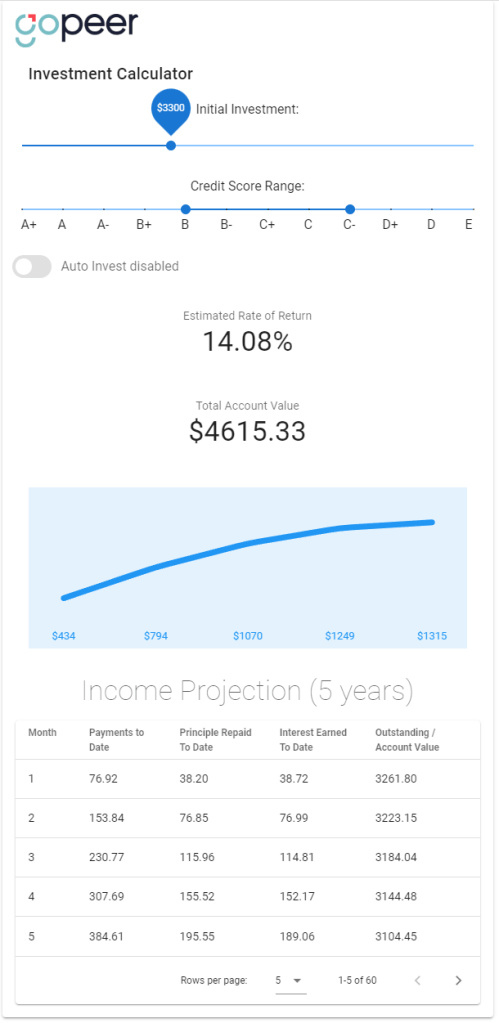
I recently blogged about my experience with goPeer so far and I’m really enjoying the service. One thing I thought it could use though is an income projection calculator. So I created one and thought I would share it. You can find it here.
How to use the calculator:
Using the initial investment slider choose the amount you would like to invest
Use the credit score slider to choose your minimum and maximum credit score range
If you are going to set your account to auto-invest, enable the auto-invest slider
Understanding the output
The tool uses the statistics published by goPeer to calculate an estimated rate of return based on the credit score range you choose. Obviously, the higher-risk loans you choose to fund increase your rate of return.
The tool outputs a Total Account Value that estimates what your total balance will be at the end of 5 years. This is because goPeer allows for 3 and 5-year repayment terms. for now, the tool just assumes that all notes are 5-year terms.
The graph projects the total interest earned at the end of each year. The table below the graph shows the monthly Payments to Date which are the cumulative total payments received, Principal Repaid to Date which is the total amount of your original investment being returned to you, the Interest Earned to Date which is the cumulative total amount of interest you have been paid and finally the Outstanding Balance or Account Value which is how much of your original investment remains to be repaid.
I hope you find it useful, and please let me know if you would like any features or enhancements in the comments below.
Lately, I’ve been trying out different passive investing services as part of my goal to generate enough passive income to live comfortably. In a recent post I talked about my experience with goPeer, a peer-to-peer lending service that is a great way to earn passive income. In this post, I’ll share my experience with Addy, a real estate investing service. There are many of these types of services in the U.S.A. but not many in Canada so I thought I would share what I’ve learned.
What’s Addy?
Addy is a real estate investing platform that aims to make real estate investing possible for everyone. Addy’s professional team identifies the real estate investment opportunities and does all the heavy lifting for you. You can invest as little as $1 and own a share (called units) in a boutique hotel in Montreal or campground in Lakefield. Super cool! Many of the investment opportunities offer a projected return of 12% or more.
How it works
First, you’ll need to sign-up for a membership which is $25 per year for a basic or $500 for a 5-year membership which comes with some extra benefits. I think they should do away with the membership fee upsell you once you’ve got past your first investment but that’s just me.
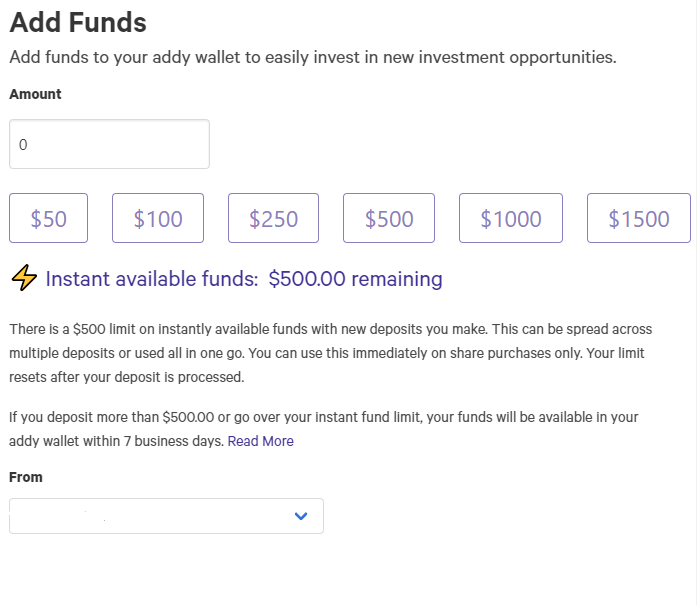
Then you will need to connect your bank account to transfer funds into your Addy wallet. This was a major sticking point for me as I’m super nervous about connecting my account so I spent a bunch of time reading up on the owners of the business, where they are located, background etc.
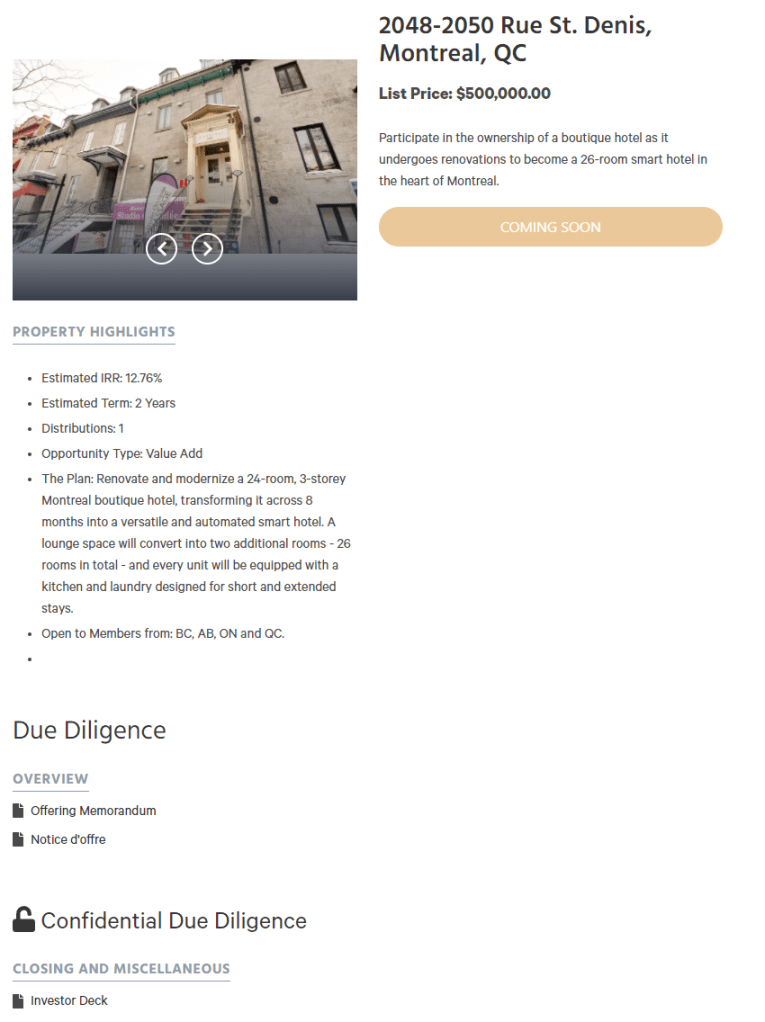
With the formalities out of the way, you will be presented with a dashboard with the usual suspects: your wallet balance, total investment, new properties etc. The property view looks like this:
From this screen, you can read more about the offer, dig into the Offering Memorandum, flip through the investor deck and if you so choose – invest in the property.
What I like (so far)
What I like so far about Addy is that you are not swamped with tons of properties to invest in and left to your own devices. Addy seems to carefully plan out each property and presents you with videos, slideshow presentations and even honest pros and cons videos. I honestly feel like I can make a fairly well-informed decision especially if I take my time to read through the very detailed offering memorandum – a 50-page document outlining all the plans, financials and potential returns.
There is something about Addy that just feels good. When I invest with Addy I feel like I’m investing in my community, city, country. Many of the projects are turning run-down buildings into low-cost rent or revitalizing an area.
So far I’ve only invested $2500 into a few properties and since my investments won’t pay off for some time I’ll probably be blogging more about my experience down the road.
If you like this summary and want to give Addy a try, please use this link. we’ll both get $25 bucks to invest in our next property!
One of my life goals is to generate enough passive income to live comfortably. One of the ways to generate more passive income is by taking part in a relatively newer approach to lending called peer-to-peer lending.
How it works:
As a borrower, goPeer makes it very easy to apply for a loan from the comfort of your home. You need to be 18 or older, have a credit score of at least 600 and have a regular source of income over $15k per year. Aside from that you must be a Canadian and have a Canadian bank account.
As a lender, after you sign up, you will be asked a few questions about your investment goals. Then you will be asked to connect your bank account to transfer funds into goPeer. This was the most stressful part for me. I actually wimped out a few times and decided to read more about the company and try again. I’m pretty comfortable having my money with goPeer so far. Depending on the loans you invest in you can expect Gross returns from 7.5% to 28%.
What to expect:
When you start using goPeer you will need to transfer some funds into the platform which can take about 5 days. I was pretty excited to use the platform and found myself logging in every day after my initial deposit to see if my funds were available to invest.
Once your funds are available you can start investing. This is easy to do. You will be presented with a screen like this which will let you pick and choose the loans you would like to invest in:
You can then drill down into each loan and view a summary of the loan details. This give’s you a simple, high-level view of the borrower’s income, the field of work, location, whether they own or rent, the purpose of the load, their credit score, debt ratio loan amount and so on. I found this very useful when I was starting out. The checkboxes indicate that goPeer has validated the information and the ‘!’ indicates they have not.
After I became more comfortable with the service I turned on the “auto-invest” feature. It’s pretty straightforward and well designed. You choose how much you want the feature to invest in each loan, select a range of credit risks and turn it on. The system will then invest into loans automatically with your settings every day.
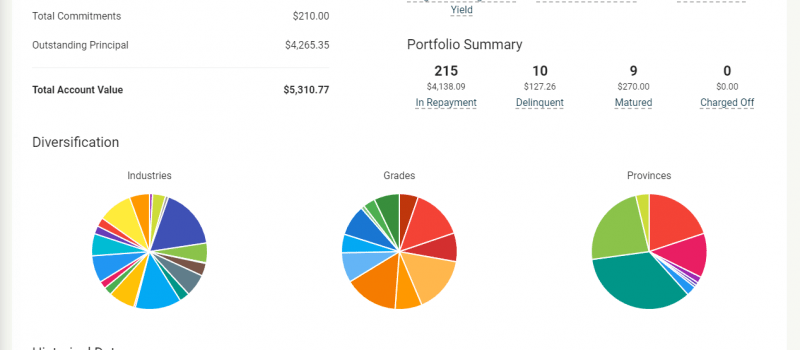
The dashboard is super clear and very user-friendly. It will give you a high-level summary of the industries, credit grades, provinces, account totals and all the high-level numbers one would expect.
I do wish they would add an income projection graph and even filed a ticket for the feature request. The support staff replied promptly, they were courteous and supportive.
goPeer says they have 4,305 investors on their platform. This is a healthy metric in my opinion because it means that you can invest a little bit into many loans on the platform which will reduce your risk of losing a bunch of money due to a borrower getting “charged out”. A term used when the borrower fails to pay their loan and is deemed unrecoverable. Everyone shares the risk.
Take your time when you start using the platform. Don’t invest too much into a single loan, spread your money around many loans and be patient. When I joined there were only a handful of loans to invest in. Avoid the temptation to overfund a loan.
goPeer also mentions that the average interest rate earned on the platform is 15.9%. That’s a pretty great return. I wish services like this existed when I was younger. The first real thing I invested in was a GIC which did not even keep up with inflation.
That’s it for now, I’ll post another update in the future with some statistics on real earnings, charge-outs etc.
Try it out for yourself! Using my referral link will help us both out: you’ll get $30 bucks and I’ll get $30.




 Life Mission